
Issue #4 - Zlotea - Refracted Memories and Source Amnesia
Refracted Memories and Source Amnesia: Arhiva Foto Dragoș Lumpan
Cătălina Zlotea
School of Design, University of Leeds
Abstract
Arhiva Foto Dragoș Lumpan is an exploration of archival material using documentary photography, editorial design, and memory studies. The archive of Dragoș Lumpan, a Romanian photographer who documented the social and political turbulence of 1990–1991 Romania, became a locus of reflection on ‘feeling’, an aspect which is not commonly considered in traditional archives. Through visual storytelling and editorial design praxis the project aims to explore the boundaries – and push conventional understanding – of documentary photography to activate collective memory and confront the societal remnants of recent historical repression and trauma.
Drawing on scholarship in intergenerational memory, trauma studies, and documentary aesthetics – such as Marianne Hirsch’s concept of “postmemory” and Ariella Azoulay’s theories on photography’s ethical responsibilities – I approached Lumpan’s archive as a space of reflection on the complex emotional landscape of a society emerging from the long shadow of communist rule. The newspaper format of the publication (Arhiva Foto 1990–1991, 2024) recalls the raw, chaotic style of post-communist press, echoed the disordered yet urgent surge of expression that followed decades of mass-media censorship by the Romanian communist regime.
The design challenges conventional “rules” of visual clarity, adopting an intentionally crowded and imperfect aesthetic to resuscitate the social instability of the time while remaining mindful of not veering into pastiche. In this way, Lumpan’s photographs become an affective archive that recalls and reawakens the visceral realities of the early 1990s, inviting people into an “experiment in feeling” that mirrors Lola Olufemi’s call to “reveal and destroy” the agents that define collective memory. Positioned at the intersection of memory studies, design practice, and post-communist identity politics, this project contributes to a growing field examining how archival and visual media can serve as both witness and catalyst for social and historical reimagining.
Introduction
This project is an exploration into the role of documentary photography in constructing and reactivating collective memory, using the archive of Dragoș Lumpan, a Romanian photographer who documented the tumultuous years of 1990–1991 Romania. This period, immediately following the fall of the communist regime, was a time of intense political and social upheaval, marked by protests, violent clashes, and an overwhelming sense of uncertainty.[i] For Romania, these years remain deeply charged, etched into the collective memory as both a traumatic end and an uncertain beginning.
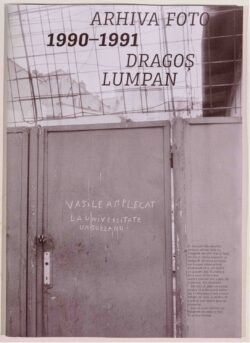
Figure 1 Front cover featuring a photograph of a metal gate with a chalk message that reads, 'Vasile, I’ve gone to the University,' likely from a protester heading to join one of the Mineriads protests. This note reflects the urgency of the time, as people gathered in Bucharest during the violent clashes between the Jiu Valley miners and protesters, marking a turbulent moment in Romania's post-revolutionary history.
The project aligns with Ann Cvetkovich’s approach, which emphasizes the need to recognise – and archive – experiences of trauma rooted in the ordinary and every day, not only in catastrophic events.[ii] It aims to explore the archive’s emotional and sensory dimensions as well as its formal one, through a design process which was guided by questions such as: How can feelings, perceptions, and emotions be captured? In what ways can the emotional resonance of an archive surface, not only in its content but also in how it is constructed, organised, and circulated?
The choice of a disordered, cumbersome newspaper format serves as a deliberate medium to both showcase the photographs and provoke a visceral response. Drawing on Diana Taylor’s idea of “the archive and the repertoire”[iii], the publication aims to capture the two years after the Romanian revolution both visually and emotionally and thus employs a deliberate “reactive” editorial design approach. In this way this project aims to transcend traditional archival engagement, instead offering an immersive experience which compels the viewer to remember, encounter, and to (re)feel the era.

Figure 2: Caption reads: “Close to Mihai Bravu, Bucharest, January 1990”

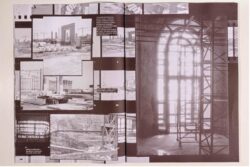
Figure 3: Captions read: “1:1 scale model for the future facade of the National Library of Romania, Bucharest, March 1990” and “Unable to interpret technical plans, Ceaușescu would request 1:1 scale models to approve them and insisted on the immediate start of construction, disregarding technical or financial difficulties.”
Source Amnesia and Intergenerational Memory
In developing this project, I took inspiration from the psychological concept of “source amnesia,” the phenomenon where individuals retain information but forget its origins. The notion of “source amnesia” encapsulated the complex ways in which memory and history interact and how collective memory can persist even as its immediate context fades. For Romania, where narratives of the post-communist transition have been passed down across generations, the events of 1990–1991 are widely remembered, but often detached from their immediate historical roots.
I belong to a generation (those born in the 1980s) that lived through those years but was too young to formulate clear personal impressions. My memories were the stories, told and retold, altered by time and interpretation, shaped by the eyes and consciousness of my parents’ generation who experienced these events directly. I regard these intergenerational memories as an evolving intangible archive, one where collective identity and personal history converge, diverge, and reshape one another.[iv] My design process brought together, in confrontation, these two archives – the intangible archive comprised of my inherited memories and Lumpan’s photography archive, an eyewitness account.
At the same time, the creative design process was guided by the sustained dialogue between me, the designer, and the photographer Dragoș Lumpan, an exchange of inherited memory and lived experience. The collaborative nature of the project therefore played a crucial role in shaping the outcome. The photographer, as the primary eyewitness and creator of the images, had his own views, sentiments, and emotional connections to the events he documented. His personal experience as an individual caught up in the whirlwind of political change, his relationship with the subjects in his photographs, and his own emotional response to the unfolding events added layers of depth and complexity to the publication. My role was to shape this archive, responding to the images and filtering them through the lens of my own intergenerationally inherited memories. I used these memories – learned from my parents and society – to contextualize the images, creating a space for reflection on the collective trauma, resilience, and eventual social awakening that marked this period in Romanian history.
This process of engaging with and reimagining these photographs was not only about historical representation; it was also about creating an emotional resonance between the past and the present. In examining these images for the first time, I was drawn into a deep reflection on how history is made and remembered, and how personal experiences, passed down through generations, shape our understanding of the world. The layout of the newspaper became a space where these memories – both personal and collective – could be explored and expressed visually and narratively.
The project seeks to reconnect these refracted memories to their source while acknowledging the inherent distance that time and perspective introduce. Lumpan’s images are more than static records of history; they are vehicles of memory, capturing moments of intense feeling that linger within Romania’s social consciousness. Through a process of editorial design and visual narrative (re)construction, the project creates a framework in which these images can evoke their original urgency while encouraging a reflective experience for contemporary viewers.
Editorial Design as Archive-Based Enquiry
Central to this project is the notion of editorial design and visual narrative as methods of archive-based enquiry. The newspaper format is chosen not only for its historical resonance with the period but also for its inherent capacity to elicit a sense of immediacy and urgency. Following the fall of communism, Romania experienced a surge in newspaper publications, which symbolized a break from decades of censorship and media control.[v] These early publications had chaotic layouts, poor print quality, and rushed production processes. Being far from polished, they mirrored the instability of the times, both in content and form.
This approach aligns with Johanna Drucker’s idea of images as spaces for interpretative activity, fostering a deeper engagement with the photographs and foregrounding their historical significance. Drucker’s concept of “refamiliarization,” which resituates images within networks of knowledge, resonates strongly with the decision to use a newspaper format for this project and to embrace the technical limitations of the uncoated paper and black-only offset printing.[vi]
In this project, the unrefined, crowded, and even imperfect design choices are not merely aesthetic; they serve as conceptual tools to reflect the chaotic nature of post-communist Romania. These design elements challenge the principles of effective visual communication, where clarity and hierarchy are prized. Instead, they are intentionally disruptive, resisting the polished aesthetics often associated with contemporary design. By embracing the unrefined design and production characteristics of Romanian newspapers from the 1990s, the publication not only mirrors the original context in which these archival photographs were first encountered but also encourages an associative reading that connects past and present. This editorial strategy echoes the disordered landscape of the period and confronts viewers with the rawness of history, urging them to “re-feel” rather than passively observe.
Through this design approach, the project aims to immerse readers in a visceral experience of memory, allowing the layout and aesthetic choices to contribute as much to the storytelling as the images and text captions themselves – often excerpts from news stories from the time. Through this medium, the project positions itself as an act of witnessing, recognizing that memory is not only something to be preserved but something to be activated, reawakened, and re-experienced.
The design choices – layout, printing technique, and paper – offer a felicitous framework for the content – photographs, snippets of articles from newspapers of the time, and personal recollections – to conjure up the experiences, reflections, and language of those who lived in early 1990s Romania. This arrangement of physical, visual, and textual elements creates a powerful, unfiltered experience, allowing even those who are unaware of these events, or did not live through them, to feel those moments rather than just observe them. In this way, the project is both evocative and documentary, presenting both personal memories and events, inviting the audience to engage with the history on an emotional level, rather than simply viewing it as a distant past. The publication is designed to encourage readers to reflect on their own position within this history, whether they are Romanians grappling with a collective past or outsiders encountering these events for the first time.

Figure 4: caption reads: “I asked Mrs. Smaranda Poenareanu, head of the office at the Social Protection Office within the Department of Labor and Social Protection, the following questions regarding disabled individuals with physical impairments: the blind, the lame, the mutilated, and those with mental disabilities: —Please, tell me first, what is the number of these disabled individuals in Bucharest and in the country? — There is no record of them, of any kind. And that’s because no one has been able to do it. Until 1970, there was a Social Protection Network within the Ministry of Health and Social Issues. In January 1970, this activity was transferred under the Ministry of Labor. The number of people engaged in this activity was (and still is today) very low. [...] To give you an idea, I can tell you that there are 7 workers for a city, and in Bucharest, one per sector!" Excerpt from the article "The Disabled", Dan Moldoveanu, Reporter, Social section, July 1990.”

Figure 5: caption reads: “Magheru Boulevard. The Mineriad. Bucharest, September 24–28, 1991 Between September 24 and 28, 1991, the fourth Mineriad took place. On September 24, 1991, the miners from the Jiu Valley went on a general strike and asked Prime Minister Petre Roman to come to Petroșani to listen to their issues. Dissatisfied with the way their demands were being addressed, the miners descended (again) on Bucharest. They stormed the government, and Prime Minister Petre Roman resigned. Upon leaving, the miners left behind 455 injured, of which 50 required hospitalization, 3 deaths from Bucharest, and one from the city of Vulcan.”
Visual Storytelling and the Ethics of Representation
Lumpan’s archive, which documents scenes of protest, struggle, and resilience, offers a powerful lens through which to explore the aesthetics and ethics of representing historical trauma. Scholars like Ariella Azoulay[vii] and Allan Sekula[viii] have extensively discussed the complex responsibilities tied to documentary photography, questioning how images of suffering and conflict should be handled in ways that honour their subjects without aestheticizing their pain. This project engages with these ethical considerations, treating Lumpan’s photographs not merely as historical artifacts but as dynamic visual narratives that demand an ethical approach to representation.
The newspaper format and the disruptive design approach serve as an aesthetic intervention, allowing the photographs to be framed within a medium that once served as a vessel for urgent information, direct address, and often, an unsettling immediacy. In placing Lumpan’s work within this format, the project seeks to challenge the sanitized lens through which historical trauma is often viewed. Rather than framing these images in a polished or commemorative setting, the newspaper design and production emphasizes their raw, unfinished qualities, suggesting that the memory of these events remains active, unresolved, and deeply embedded within Romanian collective consciousness.
Revisiting Trauma and Creating a Dialogic Space
The newspaper is intended as a space for dialogue between personal memory and collective history, aiming to evoke both the designer’s and photographer’s individual reflections as well as a broader social consciousness. The design is intentionally fragmented and layered, encouraging readers to navigate between moments and narratives, inviting multiple interpretations and connections. This approach to layout and narrative structure acknowledges that memory itself is not linear or orderly but is instead filled with ruptures, returns, and reinterpretations.
In this sense, the project serves as a dialogic space, creating a complex interplay between Lumpan’s eye-witness perspective and my reflective interpretation. This approach aligns with interdisciplinary work on memory and trauma, such as Marianne Hirsch’s concept of “postmemory,” [ix] which explores how descendants of those who experienced traumatic events come to internalize and express memories they did not directly live through.
Experimenting with Feeling and Imagining Otherwise
Responding to Lola Olufemi’s call for “experiments in feeling,” this project endeavours to uncover and dismantle the forces that “keep us here” – the lingering cinders of history that bind identity and memory to past trauma. In its newspaper form, the publication explores what it means to turn back and meet this history, to confront it directly, and to (re)feel its impact. The “messy” newspaper, the vessel for Lumpan’s evocative images, engages viewers not just intellectually but affectively, urging them to confront the emotions tied to this turbulent period and, in doing so, to “imagine otherwise.”
In this sense, the project is not merely a historical recounting; it is an invitation to imagine new possibilities for collective identity and memory, ones that acknowledge the wounds of the past without being held captive by them. By refracting and reactivating these memories, Arhiva Foto 1990–1991 calls for a re-engagement with history that allows viewers to hold the tension between mourning and transformation, between the preservation of memory and the possibility of moving beyond it.
Conclusion
Arhiva Foto 1990–1991 Dragoș Lumpan contributes to a larger discourse on the role of archives, visual media, and editorial design in shaping public memory and identity, with a focus on post-communist societies. By drawing from diverse academic contexts, including memory studies, documentary aesthetics, and critical design, this project positions itself within an emergent field of practice-based inquiry that treats archives not as static repositories but as living, affective sites of engagement.
Ultimately, this project is both a reawakening of Romania’s recent past and an exploration of how we might collectively navigate the echoes of trauma and transformation. Through this “experiment in feeling”, the project uses visual storytelling to offer a new, reflective space for confronting and reimagining Romania’s turning point, asking readers to witness, to feel, and to perhaps even liberate themselves from the weight of history.
The result is a narrative that emerges from the intersection of archival research, emotional resonance, and collaborative reflection. It is a story of personal awakening as much as it is about historical events. It emphasizes the transformative power of memory, both as an individual and collective force, and reflects on how such memories influence our understanding of history and identity. Through this project, I have sought to not only recover a moment in time but also to reactivate the emotional and historical significance of those years in a way that connects the past with the present, offering new insights into the complex process of remembering and telling history.
Endnotes:
[i] John Gledhill, ‘Three Days in Bucharest: Making Sense of Romania’s Transitional Violence, 20 Years On’, Europe-Asia Studies, 63 ( 9), (November 2011), pp. 1639–1669. Flavius Cristian Mărcău, ‘Hindering the Process of Democratization in Romania as a Consequence of the Social Protests in the early 90s’, Research and Science Today, (1), (2019), pp 69–76
[ii] Ann Cvetkovich, An Archive of Feelings Trauma, Sexuality, and Lesbian Public Cultures, (Durham: Duke University Press, 2003)
[iii] Diana Taylor, The Archive and the Repertoire. Performing Cultural Memory in the Americas, (Durham: Duke University Press, 2003)
[iv] Paul Connerton, ‘Topographies of forgetting’ in How Modernity Forgets, (Cambridge: Cambridge University Press, 2009), pp. 99–131. Karl Mannheim, ‘The Problem of Generations’, in Paul Kecskemeti, (ed.), Essays on the Sociology of Knowledge: Collected Works, Volume 5, (New York: Routledge, 1952) pp. 276–322. Maurice Halbwachs, On Collective Memory, (Chicago: University of Chicago Press, 1992)
[v] Gudrun Lingner, ‘Print Media in Romania: Struggling for Independence and Democratic Change', The Political Economy of Transition in Central and Eastern Europe in Jens Bastian (ed) (London: Routledge, 1998) Mihai Coman, ‘The Media Landscape in Romania’ Journal for Labour and Social Affairs in Eastern Europe, (4)1 (April 2001), pp. 173–186
[vi] Johanna Drucker, ‘Making Space: Image Events in an Extreme State’, Cultural Politics, 4 (1), (2008), pp. 25–46.
[vii] Ariella Azoulay, The Civil Contract of Photography, (New York: Zone Books, 2008)
[viii] Allan Sekula, ‘Dismantling Modernism, Reinventing Documentary (Notes on the Politics of Representation)’ The Massachusetts Review, (19) 4, (Winter, 1978), pp. 859–883
[ix] Marianne Hirsch, The Generation of Postmemory: Writing and Visual Culture After the Holocaust, (New York: Columbia University Press 2012)