
Issue #4 - Boukla - To Stand Despite All Possibilities to Fall
To Stand Despite All Possibilities to Fall
Eirini Boukla
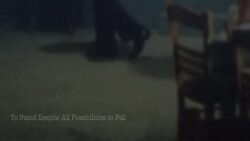
Video: 16 minutes.
Link: To Stand Despite All Possibilities to Fall
To Stand Despite All Possibilities to Fall reimagines the Zeibekiko dance, exploring its interplay with slowness, self-awareness, and a meta-pictorialism drawn from mid-20th-century Greek cinema. Drawing inspiration from Aristotle's concept of tragedy as a form of mimesis (imitation) designed as an action to provoke catharsis, this work emphasises Zeibekiko's role as an inherent cultural expression of felt emotion and resilience. The dance engages with rhythm, not through set steps. The dancer improvises as he moves in peripatetic motion, at times with his arms wide open, almost ready to soar, and at times falling to his knees, striking his palm to break the ground to enter Hades, a mimetic performance of lived experiences of loss, strength, and a moment’s freedom through solitude as an action intending to provoke catharsis.
To Stand Despite All Possibilities to Fall further explores this mimesis through editing found film footage and by reframing the scenes to show only leg and foot movement, blurring the focus and slowing down the original timeframe of the action as an attempt to provoke an experience of contemplation as a manifestation. The deliberate temporal deceleration isn't just an aesthetic choice. It's a mechanism for achieving a different kind of catharsis. Traditional tragedy builds to an emotional climax and release, leaving the audience feeling cleansed or enlightened, for example, in Sophocles' Oedipus Rex, the tragedy unfolds as Oedipus persistently pursues the truth, oblivious to the fact that he is responsible for Thebes’ misery. The emotional peak occurs when he realises that he has unknowingly killed his father and married his mother, resulting in Jocasta’s suicide and his act of self-blinding. This moment of suffering is seen as inducing the audience to experience a profound release of empathy and fear, which leaves them emotionally purified and contemplative of fate and human failings (Aristotle, 1996, p.14).
In contrast, To Stand Despite All Possibilities to Fall suspends the typical tragic climax of peak and release. Instead, it offers a prolonged, contemplative, and deferred resolve. By blurring the image, the intention is to draw the viewer’s attention to the diminished significance of a linear narrative and the visual surface spectacle in favour of experiencing the duration of the work as a contemplative surface. Through slow motion - a technical manipulation of frames per second that makes motion appear slower when viewed at normal speed - the duration of each movement is extended, amplifying the performative action of the legs. This reinforces the weight of each scene by prolonging the aesthetic of the dance, encouraging moments of absorption and reflection. This meditative approach centres on detail, focusing less on dramatic climax and simple spectacle and more on sustained emotional resonance. The rhythmic up and down of the shoe reframes the sequences into a contemplative engagement characterised by repetitious continuity, thereby extending the experience of slow movement and interaction with the dance. The absence of sound enhances this effect by eliminating aural cues that typically ground us in a conventional cinematic experience. Without dialogue, music, or ambient noise to guide our interpretation, we are left with only the nebulous movement - a rhythmic, almost hypnotic pattern of feet in motion, prompting us to ponder what is there to see and how long we must look to witness something unfold. Moreover, the absence of sound ambiguates our visual contemplation and perception of time and space. Ordinarily, in mainstream film, sound plays an emotional and structural role, providing tension, release, or climax cues. Here, its deliberate removal denies us standard pointers, leaving us suspended in an extended yet uncertain observation. This absence incites a heightened sensitivity to the minutiae of each frame, the shifting weight of a foot, the subtle trembling before the next step - a fragile balance between falling and standing.
Focusing solely on framing the lower half of the body, To Stand Despite All Possibilities to Fall diverts attention from the communicative emotions expressed through facial cues and gestures, instead emphasising bodily performativity and action. The simple motion of a foot rising and falling, along with a leg bearing weight or wavering under strain, resonates as a poetic expression of perseverance in the face of inevitable collapse. In this context, the act of standing can be perceived as a metaphor, embodying both resilience and fragility. Set alongside the Aristotelian concept of catharsis, which hinges on the emotional release elicited by a character’s suffering and demise, the work expands upon this notion by postponing such resolution. By doing so, it does not build towards a singular moment of revelation or purging, but rather, it offers a continuous returning engagement with the act of standing, an act that is both mundane and reflective.
Essentially, To Stand Despite All Possibilities to Fall operates within a space of deferred resolution, where tragedy is not simply an event with a beginning, middle, and end but rather an ongoing meditation on endurance, presence, and the delicate tension between stability and collapse. Through its technical editing (blurring, slow motion, silence, and cropped framing), the work presents the act of standing as a sustained aesthetic and philosophical inquiry, urging us to reconsider how we notice movement, time, and the act of perception.
To give further background regarding the Zeibekiko dance, its origins and history are often a matter of various opinions. However, Charitopoulos (2003) asserts that this “archaic dance of Thrace was transported by the Zeibekides to Asia Minor and brought back to Greece by refugees of 1922”, a consequence of the Greek-Turkish war and the subsequent expelling from Asia Minor. This period was a defining tragedy for 20th-century Greece, which witnessed over a million refugees evicted from their homes. Many of these displaced individuals were left destitute and stripped of their dignity, including my grandmother, grandfather, and their families.
In this context of profound loss and displacement, the Zeibekiko evolved into a powerful means to express deep grief, regret, and pain. Between the 1920s and 1950s, the dance further evolved in the Tekes (dubious taverns) of Athens, Piraeus, and Thessaloniki. It is often associated with the ‘mangas’ (under-class men known for their swagger and rebellious attitude in Greece's urban subculture), performed very slowly and often by dancers under the influence of hashish and alcohol. Later, it broadened to become an intensely personal expression of the poor, uneducated, working-class who used the dance as a release for their anger and frustrations. It is important to note that performed as an expression of bittersweet emotions - a blend of pride, joy, and sorrow - the dancer imbues the dance with their own unique, heartfelt steps, aiming to communicate genuine feelings. “Zeibekiko is a closed dance, with pain and inwardness. It is not addressed to others. The dancer does not communicate with the environment. It revolves around itself, which it places in the center of the world”. (Charitopopoulos, 2003:13-14)
To Stand Despite All Possibilities to Fall positions Zeibekiko as an exemplary figuration of Aristotle’s tragic protagonist, serving as a means to process the historical trauma and resilience of the Greek people. Moreover, while evoking personal catharsis, it can transcend a personal emotion into a shared cultural narrative. Drawing parallels between my work and Olufemi’s (2021) method of feeling, I perceive the dance as emphasising the significance of feeling in addressing and dismantling personal and cultural subjugation; it is in this feeling an opposition of vulnerability and strength is perhaps shaped and cherished in Zeibekiko. Similarly, Olufemi suggests that “feeling, to reveal and destroy what it is that keeps us here” (p.8) acts as a tool of resistance, encouraging an exploration of emotions that can often be dismissed or weaponised by oppressive systems. She also highlights the empowerment that comes from embodiment, “only when we know this can we activate the bond of the otherwise and turn back to meet it” (p.8), reclaiming individual strength through the expression of negative emotions and conscious exploration of feelings. Broadly, I see that both Zeibekiko and Olufemi share a notion that foregrounds the potentially transformative power of emotion in navigating and challenging oppression. While one emerges from a historical and cultural tradition and the other from a theoretical framework, both assert the necessity of feeling as a means of understanding, confronting, and, lastly, transcending individual and collective suffering. In doing so, they advocate for the reclamation of emotional and physical space, positioning feeling as an embodied expression and as an essential tool for both personal liberation and broader social transformation.
My relationship with To Stand Despite All Possibilities to Fall is both cognitive and personal. Although much of this explanation centres on the viewer’s experience and the broader cultural context of Zeibekiko, the motivation behind this work is grounded in my own lived experiences, family history, and dear reflections shaped by traces of memory through the telling of movement and displacement both metaphorically and literally.
This work stems from a desire to understand and process inherited trauma and resilience passed down through generations, particularly through the lens of my grandparents, who were among the Greek refugees displaced during the 1914-1922 population exchange between Greece and Turkey. Like many others of that time, they were forced to rebuild their lives in unfamiliar places, in poverty, grappling with the loss of home and, more importantly, identity and dignity. These stories relayed to me through fragmented family memories become formative in shaping my awareness of vulnerability, strength, and cultural survival. Zeibekiko, as a dance form emerging from that historical rupture, has always resonated with me not simply as a familiar cultural artefact but as a deeply personal expression of defiance, grief, and pride.
The creation of this work became a means of entering dialogue with the scars of the past, ones that were not necessarily mine but which I carry, nevertheless. My use of found footage and its re-editing was an intentional act of reclaiming and reframing fragments of a past I did not live first-hand but continue to feel the reverberations of. In focusing solely on the lower body and stripping away the sound, I look to the way the weight of remembered sorrow and stories often come to us: partial, embodied, and laden with silence.
Thus, I decided not to record myself performing Zeibekiko. Instead, I turned to found footage, drawn to its archival distance, a removal that I thought opened up space for reflection while also acknowledging my position as someone engaging with memories lived through the feelings of others. Nevertheless, through the act of editing, slowing the footage, blurring it, and isolating the feet, I place myself within the work, not as an external observer but as someone culturally rooted, wrestling with what it means to carry and translate the cultural residue of memory into a visual language of motion and pause. This process, at times, emotionally laborious, was not simply about exploring Zeibekiko but also about feeling my way through it, using the dance as a conduit of sentiments that often can resist articulation. Further, this work became a form of mourning, of reaching back across time to understand how bodies can hold, transmit, and transform suffering. It is also an exploration of what it means to stand despite loss, despite exile, despite the near, constant possibility of collapse.
In the end, ‘To Stand Despite All Possibilities to Fall’ is a personal offering. It is a space where I grapple with feeling, embodiment, and the ongoing process of locating myself within a cultural lineage of resilience. It is an attempt to translate inherited sorrow into a visual and temporal language that invites both contemplation and catharsis – not only for the viewer but also for myself.
References:
Aristotle, 1996. Poetics. Translated by M. Heath. London; Penguin Books.
Charitopoulos, D. 2003. The lonely lament, in Us Ourselves. Athens; Topos. Pp. 13-14.
Cowgill, J. (1998). Dance and the Body Politic in Northern Greece. Princeton University Press.
Holst-Warhaft, G. 1992. Dangerous Voices: Women's Song and Tradition in Modern Greece. Routledge.
Mazower, M. 2000. After the War Was Over: Reconstructing the Family, Nation, and State in Greece, 1943-1960. Princeton University Press.
Olufemi, L. 2021. Experiments in Imagining Otherwise. United Kingdom. Hajar Press