
Issue #4 - Duxbury - On Becoming A Ghost
On Becoming A Ghost
Michelle Duxbury
Video and Audio
15 minute loop
Video Link: On Becoming A Ghost
Website: michelleduxbury.studio
This work explores several themes that thread through my practice around the impact of isolation and exclusion from society on the very essence of our identity and how we feel about our own existence. Whilst this work is directly informed by my experience of disability and chronic illness, and was obviously very relatable to the experience of lockdown when it was made in early 2022, it seeks to acknowledge that this experience of isolation and exclusion from society is actually a perpetual state of existence for many disabled people. There has never been a normal for us, new or otherwise. Only by confronting that, might we start to reimagine what our existence could be.
The soundscape in the work was created from photographic images produced for the solo show of the same name in which it featured, using digital software that can translate images into sound. It was the first time I had experimented with this approach to creating sound in my practice. In the gallery space the soundscape and spoken audio were detached from the film and played directly into the space at intervals. This creative approach to embedding accessibility in the work through a multi-layered experience of the work allowed audiences to find a way into the work that suited them. I have attempted to replicate this experience in this 15 minute loop version of the video.
- - -
At the time I made this work in 2022, I could never have imagined I would be writing about it for an academic publication as a PGR researcher. In fact, I didn’t even really consider myself a proper artist at that point.
I don’t have a formal arts education. My art practice has always been intuitive, sensorily led, responsive to my emotions, experimental. I had very limited access to resources, using whatever equipment and materials I had to hand. I worked mainly from my bed due to my chronic illness.
In a previous life, in a previous world, before chronic illness, I studied sociology. So I knew that my art work was auto-ethnographical in nature. I knew that the things I felt, the experiences I had, the things I read, the things I watched, all informed the work I produced. I understood the theories of marginalisation and exclusion. I knew I wanted to share my work to take up space, to raise my voice. But I certainly wasn’t considering my artistic practice within an academic framework at that time.
On Becoming A Ghost was a visceral response to feeling invisible, an early experiment in translating and expressing these emotions. I wanted it to be a visceral experience for the audience too.
I had already started exploring ways that my work could be more immersive, experienced through multiple senses, to make it more accessible to disabled audiences. I was particularly interested in how one sense might be experienced through another sense, for example how you might see a sound. To this end I had begun experimenting with creating visual representations of some of my field recordings using an audio editing software called Audacity.[i] The spectrogram view in Audacity produces a visual representation of the sound frequencies in the uploaded recording. There are a few buttons and parameters you can fiddle around with, which I do until I find the version of the image that feels right. The spectrogram image is then screenshot and converted into a cross-stitch pattern using a software called MacStitch[ii] to produce a series of site-specific ‘stitched soundscapes’ that invite the audience to simultaneously see, hear and feel the work.
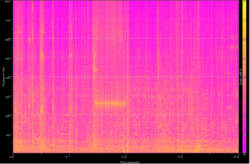
Image One: screenshot of a spectrogram view of one of my field recordings
When it came to creating the soundscape element for On Becoming A Ghost, I felt the need to go beyond using the sound recordings I had taken of my daily life around my house, which I believed were inadequate to represent the emotional intensity and depth of somatic experience I wanted to express in the work. Having already experimented with creating image from sound, I was keen to try the reverse and transform images into sound. After doing a bit of research I discovered an online video synthesiser called PixelSynth[iii] that allows you to upload images and transform them into sound. The user interface provided multiple options to impact on the way the image sounded, meaning a number of sound clips could be created from a single image.

Image Two: screenshot of two versions of one photograph in PixelSynth
As part of the process of researching and documenting this body of work I had created a series of photographic images using my camera phone, that were printed out onto Polaroid film using a Polaroid Lab. These photographic images were intended to capture and reflect the almost invisible traces of my existence. One series of images titled Traces I, captured shafts of light on the walls of my bedroom. After experimenting with various images, I found I was getting the best results from images with the highest contrast, so the final selection was taken from Traces I and some stills from the video work.
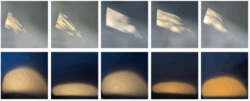
Image Three: Traces I
The sounds that emerged were wonderfully rich and emotive, clanky and industrial, overbearing and unsettling - unlike anything I could have produced through field recordings. Those sounds embodied exactly how I was feeling and the somatic responses I was experiencing in my life that I wanted to share with the audience. As there was no option available to download the sounds created in PixelSynth I had to rely on extracting sound files from screen recordings to edit the tracks together to make the final soundscape. My editing process is very intuitive. I have no formal training in composition and rarely have a plan in advance of how the soundscapes will come together. I just experiment with layering the sounds I have until it feels right. Sometimes it comes together gloriously fast and sometimes it’s an incredibly laborious process.
At this point, I should hold my hands up and acknowledge that, as with most of these digital audio tools I use to create my work, I am often completely uneducated in how to use them to their proper capabilities and offer my sincerest apologies to any experts out there who are aghast at such impudence! Yet I strongly believe that this relative lack of expertise and using these tools in ways they were perhaps not originally intended, gives me an enviable permission to explore and experiment without constraint, and a freedom to respond intuitively and elevating the somatic responses I often rely on to navigate the world as a disabled person.
Epilogue
In more recent times, I have become familiar with the work of Pauline Oliveros. This has provided me with an opportunity to explore an interesting contextualisation of several key elements of On Becoming A Ghost within a broader academic theoretical framework.
In Quantum Listening, Oliveros asks “Can sounds be understood as particles?”[iv] and contends that sounds near one another are able to influence one another. I have found myself wondering if I create particles of sound from the almost imperceptible particles of my existence captured in the photographs, and if particles of sound can influence other particles of sound, does this make me less isolated in a world in which I feel invisible? If people can’t see me maybe they can hear me? Can they feel or sense my presence through my sonic pictures? These are questions that I am exploring in my doctoral research, which explores the challenges of making site responsive landscape-based work as a disabled artist, appropriating the ghost as a metaphor for my lived experience of disability to propose new ways of working as a disabled artist and reimaging a radical experience of the landscape that moves beyond the physical.
The use of spoken word in the work was another, unexpected, departure for me. Any consideration of words in my practice had previously only been in the context of naming work. During the processes of editing the soundscape, as I listened to the tracks over and over again, intuitively seeking the perfect mix, I began to hear sounds that weren’t really there. The repetitiveness became disorientating and unsettling and these words burst to the surface, perhaps drummed from my subconscious. There are two statements in the introduction to Quantum Listening, written by IONE, that resonate deeply with my experience and to which I provide my own response:
“As I write, I listen”[v]
As I listened, I wrote.
“As I write and listen, hidden sounds emerge”[vi]
As I listened, hidden sounds emerged.
Scuff Marks
a trail of scuff marks
small dark smudgy remnants
the proof we existed
the proof we were there
On Becoming A Ghost
it takes longer than you’d think
to become a ghost
painfully slow and monotonous
being left behind
excluded
gradually erased
‘just stay home and let the rest of us live our lives’
to bastardise an old saying
‘If we stay locked away forever
and nobody hears our screams
do we even exist anymore?’
my life is not worth less
my life is not worthless
‘but we just need to get back to normal’
normality doesn’t exist
it’s nothing more than a divisive and condescending myth
a comforting conceit in the supposed superiority of your normalness
a justification not to care
‘can’t you just stop being so dramatic’
My ghost will be filled with vengeance and wrath
My ghost will haunt you
Dancing Light
a shaft of light
piercing through the solitude
dancing playful
across the painted white plaster of the wall
gradually it fades…
leaving behind
no trace
it ever existed.
- - -
References
[i] The Audacity Team, Audacity (2000), Windows, macOS, Linux
[ii] Ursa Software, MacStitch (2008), macOS
[iii] Oliva Jack, PixelSynth (2016), Browser-based
[iv] Pauline Oliveros, Quantum Listening (Spiral House, 2024), p55
[v] IONE, ‘Introduction’ in Pauline Oliveros, Quantum Listening (Spiral House, 2024) pp. 9-24
[vi] IONE, ‘Introduction’ in Pauline Oliveros, Quantum Listening (Spiral House, 2024) pp. 9-24